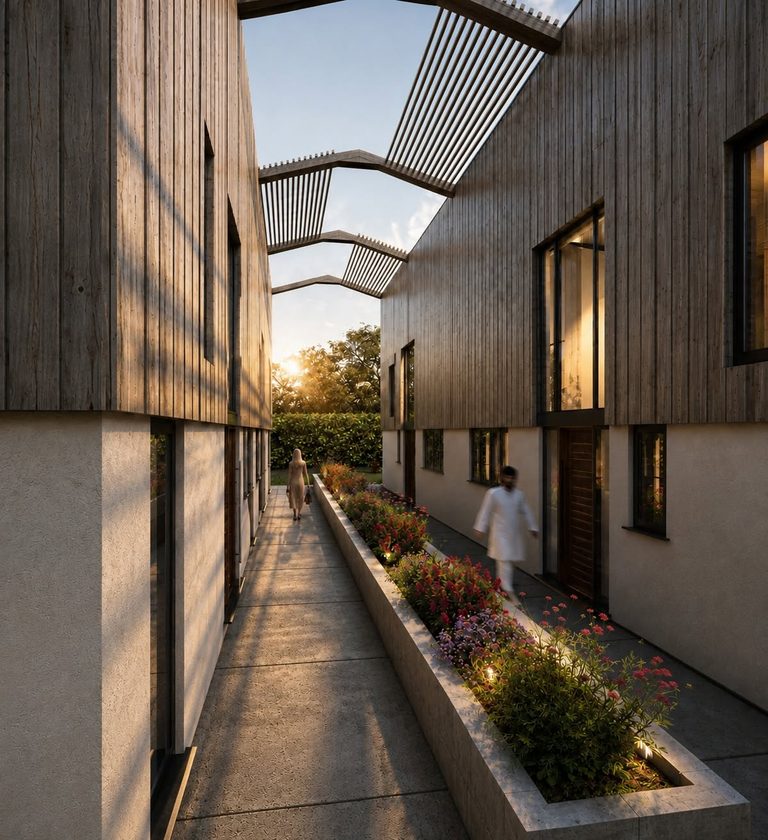
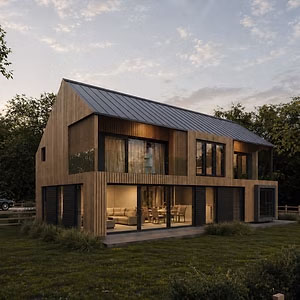
We’re delighted to have secured planning permission for a new dwelling in North Devon, replacing an extant Class Q Prior Approval permission for the conversion of the original agricultural barn.
This one has taken its time, with plenty of back and forth along the way, but we got there in the end! A big thank you to North Devon Council’s Planning Department, who took a pragmatic approach throughout and worked with us to develop an acceptable solution for what is a sensitive rural site.


The proposal utilises the established ‘fall-back’ position created by the existing Class Q approval. In simple terms, the principle of a dwelling on the site had already been established through the approved barn conversion, allowing us to demonstrate that a purpose-designed replacement dwelling could deliver significant public and environmental betterment over the consented scheme.
A key part of the design is the way the new home is built into the naturally sloping site. This significantly reduces its perceived massing and visual impact within the landscape, while also using the surrounding ground as a thermal bank to help passively regulate internal temperatures and improve the building’s overall thermal performance.
The dwelling has been designed around a strong sustainability and fabric-first approach, incorporating high levels of insulation and airtightness alongside technologies including ground source heating, solar panels, MVHR and rainwater harvesting.
Natural and locally appropriate materials including slate, timber, stone and render will help the building sit comfortably within its rural North Devon setting, while ICF construction will provide excellent thermal efficiency and airtightness.
Projects like this are very much a team effort, so a huge thank you once again to James at Helix Transport Solutions, whose input was invaluable in securing a new access for the proposed dwelling.
Thanks also to Vince Steele at Steele Landscape Design, Colin Wills at Wills Ecology, and Steph, Greg and Tom at Energy Report, who helped us demonstrate the thermal-performance betterment achieved by integrating the dwelling into the bank.
It may have taken a little longer than we first hoped, but this is a great example of what can be achieved through persistence, collaboration and a carefully considered planning strategy.
Now onto the next stage — bringing it to life!